
We are proud to announce the publication of our latest research in the journal Renewable Energy. This marks the second major paper published by the CURA Lab since our launch last year, continuing our mission to bridge the gap between climate science and architectural engineering.
As the global climate shifts, can the high-performance houses we build today maintain their “Net-Zero” status decades from now? Our latest study, titled “Assessing the long-term feasibility of net-zero energy houses in Slovenia: Impacts of climate scenarios, roof design, and technological progress,” tackles this question head-on.
The Research
Led by Luka Pajek, alongside CURA Lab’s Marco S. Fernandes and Eugénio Rodrigues, the team employed a massive bottom-up modeling approach. We simulated over one million energy models across 12 Slovenian cities, integrating the latest CMIP6 climate projections (SSP2-4.5 and SSP3-7.0) with various scenarios for technological advancements in HVAC and photovoltaic (PV) systems.
Key Findings
The study reveals a dynamic “race” between rising temperatures and technological innovation. Key takeaways include:
- Technology vs. Climate: In optimistic scenarios, the efficiency gains in PV and HVAC systems are projected to significantly outweigh the increased cooling demand caused by a warming climate.
- The Winter Challenge: While summer energy needs are easily met, achieving a year-round energy balance remains difficult in colder regions during winter.
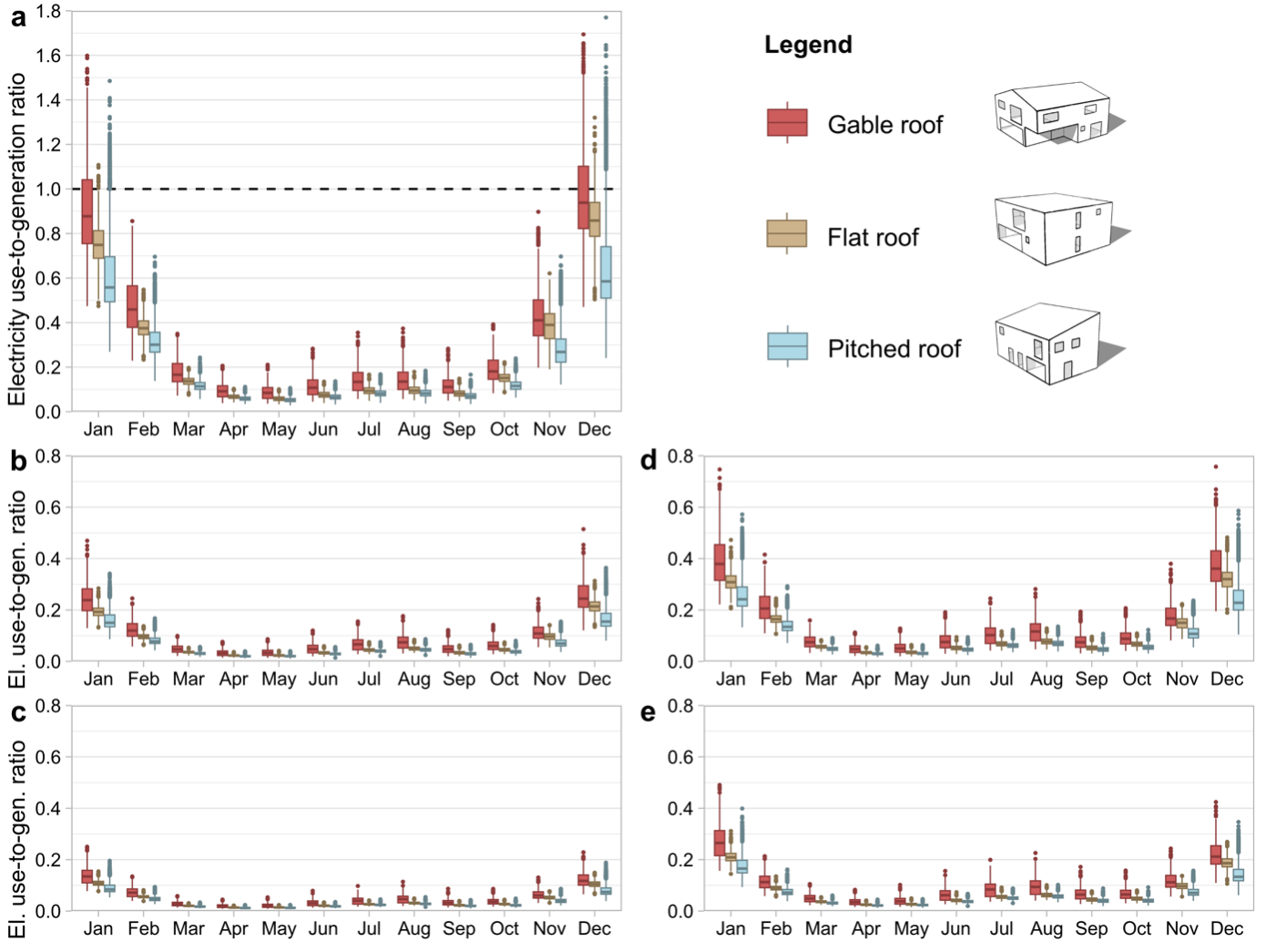
- Roof Design is Decisive: The study highlights a conflict between traditional aesthetics and energy performance. Gable roofs—often mandated by local urban planning—perform poorly for PV generation compared to pitched or flat roofs. In some regions, restrictive roof requirements can be the single factor that prevents a building from reaching NZEB status.
- Policy Implications: Our results suggest that Slovenia’s path to a carbon-neutral building stock requires a shift from “one-size-fits-all” urban planning toward flexible, site-specific design frameworks that prioritize renewable energy potential.
Why It Matters
This research provides a robust, evidence-based roadmap for architects, engineers, and policymakers. It proves that while long-term NZEB status is attainable in Slovenia, it requires a conscious departure from rigid design traditions in favor of climate-responsive architecture.
Read the Full Paper
We invite you to explore the data and detailed findings of this study. The paper is available as an Open Access publication: https://www.sciencedirect.com/science/article/pii/S0960148126001400.